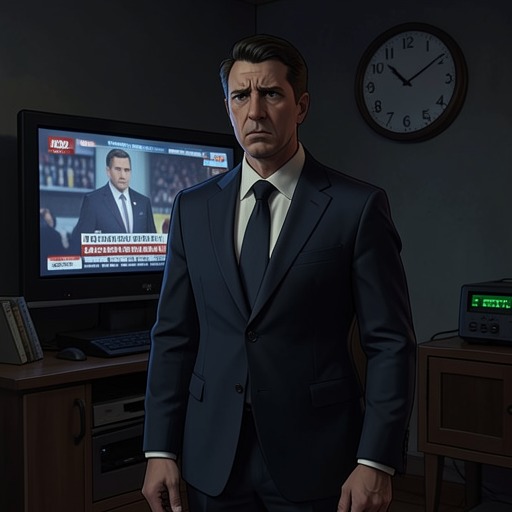
Jean Farrow attacked by motorcycle
Les Choses humainesThe motorcycle attack on Jean Farel turns his public visibility into a physical vulnerability: two helmeted men knock him to the pavement in central Paris, and he leaves with a bruised arm and a torn trouser leg. He refuses immediate help, checks for photographers, and returns to work before asking his son Léo to find him a gun.
The attack in public
Jean is crossing the Champs-Élysées after an unusually successful broadcast, pausing along the way to give passersby autographs and photographs. He is checking Twitter when two helmeted men on a motorcycle suddenly appear and propel him sideways. He falls near a newspaper kiosk and remains unconscious for several seconds. When a passerby hurries over to help, Jean pushes him away and insists that he is fine. His next concern is whether a photographer has captured the assault, a reflex that makes the threat to his image visible alongside the threat to his body.
Injury, secrecy, and the return to work
The attack leaves visible evidence even as Jean tries to contain its public meaning. His trousers are slightly torn and his left arm badly bruised; after reaching the radio station, he changes clothes with his assistant’s help while the makeup artist covers the red marks on his hands. The concealment is practical as well as theatrical: filmed interviews and photographs for the station’s social-media accounts have made appearance part of the broadcast routine, and the staff have been told to keep communicating. The assault interrupts that machinery only briefly. Jean proceeds with his interview, pressing a left-wing politician and novelist with sharp questions, then disparaging her to his team after she has answered him forcefully. No one joins in; their silence reflects the cost of contradicting a presenter on whom their jobs depend.
Aftermath and the demand for a weapon
Once Léo arrives to drive him, Jean recounts the assault. Léo asks whether Jean saw the attackers’ faces; Jean says they were helmeted. Léo urges him to hire a bodyguard because he is too exposed, but Jean refuses. The exchange leaves the perpetrators unidentified and the threat unresolved: the attack is clearly described as premeditated, yet Jean has no answer to who arranged it or why.
Jean asks Léo to take him to Bichat hospital, where Françoise has been admitted after a suicide attempt. As they drive, Charles Aznavour’s song “Il faut savoir” plays on the radio; Jean opens the window to the icy air and asks Léo to hurry. Then, abruptly, he asks him to find a gun, specifically a Beretta or something similar. Léo switches off the radio and asks what he means. The request connects the assault to a larger crisis in Jean’s life, but the scene does not identify the intended target or establish what he will do with a weapon. The motorcycle attack thus ends not with reassurance or resolution, but with Jean turning from public composure toward a potentially lethal response.
The assault amid a public crisis
The attack occurs as Jean’s carefully maintained public image is colliding with private upheaval. Earlier, after receiving a decoration from the President, he posted a celebratory tweet misspelling “honneur” as “horreur.” Mockery spread online, and although he deleted the post, screenshots continued to circulate. The next morning, another tweet—celebrating an exceptional broadcast audience of nearly five million—was retweeted by his colleague Ballard. Jean was checking the praise and accepting requests for autographs and photographs when the motorcyclists struck. The sequence places his exposure to public scrutiny beside his physical exposure on the street: online attention and celebrity offer him access and affirmation, but neither protects him from violence.
The assault also lands against the upheaval surrounding his family. The news that his son Alexandre had been taken into police custody on suspicion of rape soon reached the press through an Agence France-Presse report, despite Jean’s request that the matter remain confidential. The public disclosure threatened to stain Jean’s own name and reputation, while messages from journalists flooded his and Claire’s phones. These surrounding pressures do not identify the attackers or establish a motive for the assault. Rather, they make the question Jean asks—who could have arranged it?—part of a wider atmosphere in which his family’s private crisis is becoming public spectacle.
Public performance and concealed injury
Jean does not let the attack interrupt his professional routine for long. At the radio station, his assistant helps him change, and a makeup artist disguises the red marks on his hands. The concealment matters in a workplace where interviews are filmed and a staff member posts photographs of Jean with his guest to the station’s social-media accounts. Communication has become an explicit obligation for the team; even an injured presenter is expected to remain presentable and visible.
He conducts the interview with a young left-wing politician who is also a novelist, asking sharp questions and challenging her about the relative ferocity of political and literary circles. She answers by invoking Beckett’s warning that morning is the time to hide, describing the danger of people waking hungry for order, beauty, and justice. Jean closes the interview by telling her she has passed the dangerous passage, then leaves the studio and calls her a pit bull to his technicians. His colleagues do not echo the insult. Their silence makes the power imbalance inside the station tangible: Jean can turn his public-facing composure into a performance, while those around him have reason to keep quiet.
The unresolved threat
When Léo collects him, Jean recounts what happened. Léo asks whether he saw the attackers’ faces; Jean says they wore helmets. Léo advises him to hire a bodyguard because he is too exposed, but Jean refuses. The attackers remain unidentified, and the narrative offers no confirmation of who sent them or what they wanted. Jean’s suspicion that the assault was premeditated remains unanswered.
Jean asks Léo to take him to Bichat hospital to visit Françoise, who has been hospitalized after a suicide attempt. As Charles Aznavour’s “Il faut savoir” plays, Jean opens the window to the cold air and tells Léo to hurry. He then abruptly asks him to find a weapon, naming a Beretta as one possibility. Léo turns off the radio and asks what he means. The request follows the assault but is not explained: the scene does not state whom Jean might target, whether the weapon is connected to the motorcyclists, or whether he will act on the request. It closes on an unresolved turn from bodily vulnerability and managed public appearance toward the possibility of lethal violence.